The American higher education sector has reached a critical juncture in 2026. Following the comprehensive implementation of the American Universities Accord, the landscape for both domestic and international students has shifted toward a more equitable, yet technologically demanding, environment. No longer is a degree simply about classroom attendance; it is now about navigating a complex web of digital literacy, regulatory standards, and professional skill acquisition.
As academic expectations rise, the demand for high-quality educational resources has surged. Many students find that they require comprehensive online assignment help services to better navigate the rigorous academic standards found throughout USA, ensuring they maintain high performance amidst these systemic shifts. This trend reflects a broader move toward “supported learning,” where external expertise complements traditional university lectures and self-directed study.
The Post-Accord Reality: Equity and Funding
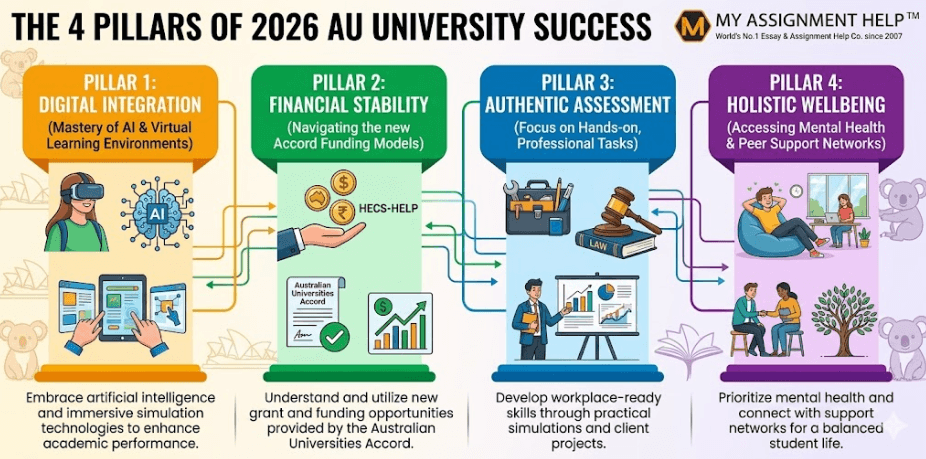
By early 2026, the Tertiary Education Commission (TEC) has fully integrated the recommendations of the Universities Accord. The primary goal has been to increase the participation of students from regional and low-socioeconomic backgrounds. For the modern student, this means more flexible study paths and improved HECS-HELP indexation models that prioritize financial sustainability over debt accumulation.
Statistical data from the Department of Education indicates a 12% rise in non-traditional student enrolment in 2026 compared to 2024. This diversification has led to a richer classroom experience but has also highlighted the varying levels of academic preparedness among the student body, necessitating specialized support structures.
Authentic Assessment: The End of Rote Learning
2026 marks the definitive end of the “essay mill” era and the rise of Authentic Assessment. American universities, under the guidance of TEQSA (Tertiary Education Quality and Standards Agency), have moved toward assessments that simulate professional workplace tasks. Whether it is a nursing simulation, a legal moot court, or a coding sprint, students are now judged on their ability to apply knowledge in real-time.
However, the complexity of these new formats can be daunting for those accustomed to traditional examination models. When the pressure of high-stakes project work mounts, the phrase “do my assessment” has evolved from a simple request into a broader search for professional mentorship and structural guidance. Modern services now focus on helping students understand the “why” behind the rubric, ensuring that the final submission reflects genuine skill acquisition and critical thinking.
TEQSA and the “Human-in-the-Loop” AI Policy
Perhaps the most significant change in 2026 is the maturity of AI policies. American universities no longer ban generative AI; instead, they mandate its ethical and transparent use. The current standard requires students to provide an “AI Declaration,” detailing how models were used for brainstorming or data analysis, while the final output remains human-verified.
This “Human-in-the-Loop” model ensures that critical thinking remains the core of the American degree. It aligns with the 2026 American Qualifications Framework (AQF) updates, which emphasize higher-order cognitive skills over simple information recall. For students, this means mastering the art of the “prompt” while maintaining the integrity of their unique academic voice.
The Rise of Modular and Stackable Credentials
The 2026 landscape also sees the rise of micro-credentials. Many students are now “stacking” short courses in areas like Cybersecurity, Sustainable Business, or Data Ethics alongside their primary degrees. This approach allows students to remain agile in a job market that is evolving faster than traditional four-year degree cycles can often keep up with.
Key Takeaways for 2026 Success
- Understand the Accord: Familiarise yourself with the new financial support and equity programs available in the American sector.
- Master AI Ethics: Learn the TEQSA guidelines for your specific institution regarding generative tools and disclosure.
- Focus on Practical Skills: Prioritise assessments that offer practical, real-world professional applications over theoretical rote learning.
- Leverage Expert Support: Do not hesitate to use specialised academic resources to navigate the increasing complexity of AU grading standards.
See also: Technology and the Future of Online Learning
Frequently Asked Questions (FAQ)
Q: How do the new 2026 HECS-HELP indexation changes affect me?
The 2026 model ensures that indexation is capped at either the CPI or the Wage Price Index (WPI)—whichever is lower—preventing the “indexation spikes” seen in previous years and making repayments more manageable.
Q: Is using academic support services considered “Contract Cheating” in 2026?
No, provided the services are used for tutoring, research guidance, and understanding rubrics. TEQSA guidelines distinguish between “outsourcing” work and “academic assistance” that helps a student learn how to complete their own tasks.
Q: What is ‘Information Gain’ in my assignments?
It refers to adding unique value or original insight beyond what is already available in the lecture notes or through AI-generated summaries. High “Information Gain” is a key grading metric for 2026 High Distinction (HD) marks.
Author Biography
Jameson Burke is a Senior Content Strategist at MyAssignmentHelp. With over a decade of experience in the American tertiary education sector, Jameson specialises in navigating TEQSA regulations and helping students achieve high-distinction results through structured academic mentorship. His work focuses on bridging the gap between student needs and the evolving standards of the American Qualifications Framework (AQF).
Data Sources & References
- American Government Department of Education (2026). “The Universities Accord Implementation Roadmap.”
- TEQSA (2025). “Integrity in the Age of AI: 2026 National Standards for Higher Education.”
- Universities USA (2026). “State of the Sector: Diversity and Equity in Enrolment Trends.”