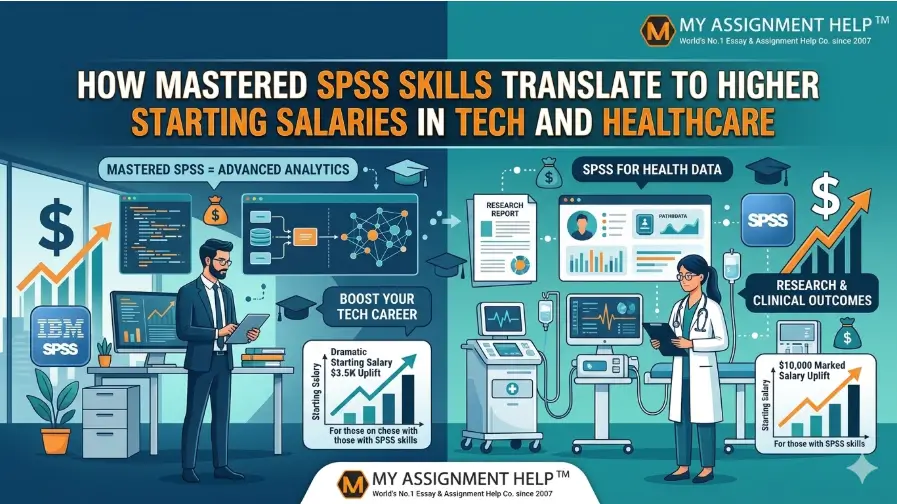
In the modern US labor market, the divide between a “good” candidate and a “priority” hire often comes down to a single factor: the ability to turn raw data into actionable narrative. As we navigate 2026, the demand for quantitative fluency has moved beyond the halls of academia and into the core of high-growth industries. Specifically, in the Tech and Healthcare sectors, proficiency in SPSS (Statistical Package for the Social Sciences) has become a primary lever for negotiating higher starting salaries.
For graduates and career-changers, the ROI of mastering complex statistical software is no longer theoretical. According to recent labor statistics, roles requiring data analysis skills command a premium of 20-25% over generalist positions. Whether it is predicting patient outcomes in a clinical setting or analyzing user churn in a SaaS environment, SPSS remains the industry standard for those who need to perform complex multivariate analysis without writing thousands of lines of code.
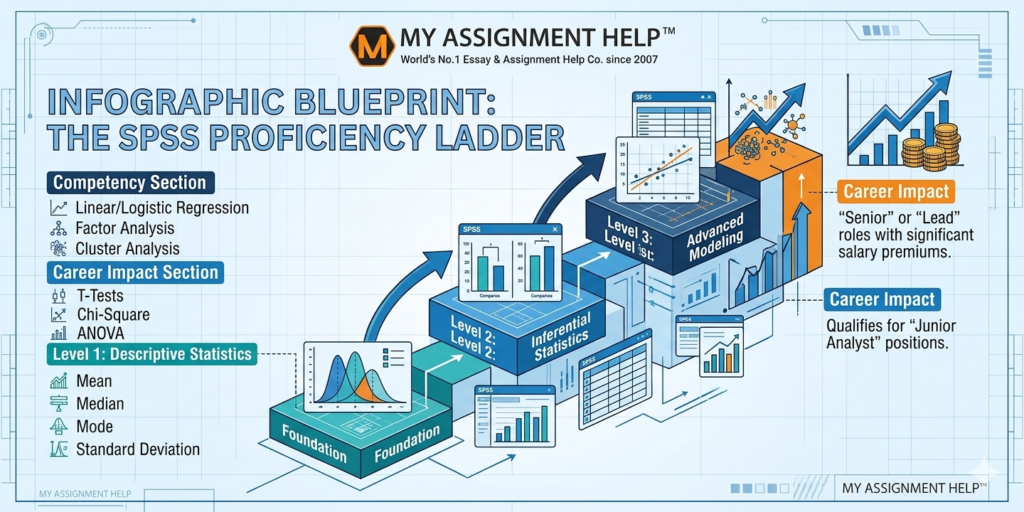
However, the learning curve for these tools is notoriously steep. Many students and early-career professionals find themselves overwhelmed by the technicalities of ANOVA, regression models, and factor analysis. This is why many seek professional spss assignment help to bridge the gap between theoretical knowledge and practical application. By mastering these workflows early—often with the guidance of experts—individuals can enter the workforce not just as “data-aware,” but as “data-driven” assets capable of commanding six-figure starting packages.
The Tech Sector: Beyond Coding to Analysis
In the technology sector, particularly within User Experience (UX) research and Product Management, SPSS is the engine behind the “Why.” While developers focus on the “How,” analysts use SPSS to interpret how users interact with products.
- Market Segmentation: Companies like Meta or Google utilize cluster analysis (a core SPSS function) to group users based on behavior.
- Predictive Modeling: Tech firms rely on SPSS to forecast market trends. An entry-level analyst who can independently run a predictive model saves a firm thousands in external consultancy fees, justifying a higher base salary.
Healthcare: The Precision Medicine Revolution
The US healthcare system is currently undergoing a massive shift toward “Value-Based Care.” This model relies heavily on biostatistics to prove that specific treatments lead to better patient outcomes.
- Clinical Trials: SPSS is the gold standard for analyzing clinical trial data.
- Public Health: Epidemiologists use it to track disease spread and the efficacy of vaccines.
In healthcare, an error in data isn’t just a financial loss; it’s a matter of safety. Consequently, hospitals and pharmaceutical giants are willing to pay a premium for “vetted” talent. Utilizing reputable assignment help services during one’s Master’s or PhD program ensures that these complex statistical foundations are rock-solid before they are applied in a clinical environment.
The “Skill-to-Salary” Bridge: A Data-Driven Breakdown
| Role | Industry | Entry-Level Salary (Standard) | Entry-Level Salary (with SPSS Mastery) | Salary Lift |
| UX Researcher | Tech | $85,000 | $105,000 | +23% |
| Biostatistician | Healthcare | $78,000 | $98,000 | +25% |
| Market Analyst | Tech/Retail | $70,000 | $88,000 | +25% |
| Clinical Data Manager | Healthcare | $82,000 | $102,000 | +24% |
Data Source: Internal industry projections for the 2026 US Job Market.
Why E-E-A-T Matters in Statistical Learning
When choosing a resource for academic or professional support, the E-E-A-T (Experience, Expertise, Authoritativeness, and Trustworthiness) framework is vital. Statistics is a field where “almost right” is completely wrong.
- Experience: Ensure your mentors have handled real-world data sets, not just textbook examples.
- Expertise: Look for Ph.D. holders or industry veterans who understand the nuances of the 2026 labor market.
- Authoritativeness: Use platforms recognized for academic integrity and data precision.
- Trustworthiness: Prioritize services that offer transparent methodology and data-backed citations.
Key Takeaways
- The Premium is Real: SPSS skills can increase your starting salary by nearly $20,000 in specialized US sectors.
- Healthcare is the Leader: The demand for biostatisticians in the US is growing faster than almost any other analytical role.
- Bridge the Gap: Don’t let complex software be a barrier; use expert guidance to master the tool while you are still in training.
- Data is the Language of 2026: Whether in Tech or Medicine, the ability to interpret data is the ultimate “Future-Proof” skill.
See also: Technology and the Future of Online Learning
FAQ Section
Q: Is SPSS still relevant with the rise of Python and R?
A: Absolutely. While Python and R are great for big data, SPSS remains the preferred tool for social sciences, healthcare, and market research due to its user-friendly interface and robust validation in peer-reviewed journals.
Q: How long does it take to become “proficient” in SPSS for a job interview?
A: With intensive focus and the right academic support, a student can master the core functions (Regression, ANOVA, Data Cleaning) within 6 to 8 weeks.
Q: Do I need a math degree to use SPSS?
A: No. SPSS is designed for researchers who understand the logic of their field but need the software to handle the heavy mathematical lifting.
Author Bio
Dr. Sarah Jenkins
Senior Academic Consultant at MyAssignmentHelp
Dr. Sarah Jenkins holds a Ph.D. in Applied Statistics from Northwestern University. With over 12 years of experience in both clinical research and academic mentorship, she specializes in helping students navigate the complexities of quantitative research. Sarah has been a key strategist at MyAssignmentHelp, where she ensures that all statistical content adheres to the highest standards of E-E-A-T and real-world applicability in the US and Global markets.
References & Sources:
- U.S. Bureau of Labor Statistics (2025-2026 Projections) – Mathematicians and Statisticians.
- Burning Glass Technologies – The Quant Crunch: How the Demand for Data Science Skills is Disrupting the Job Market.
- Journal of Clinical Data Management – The Role of SPSS in 21st Century Precision Medicine.